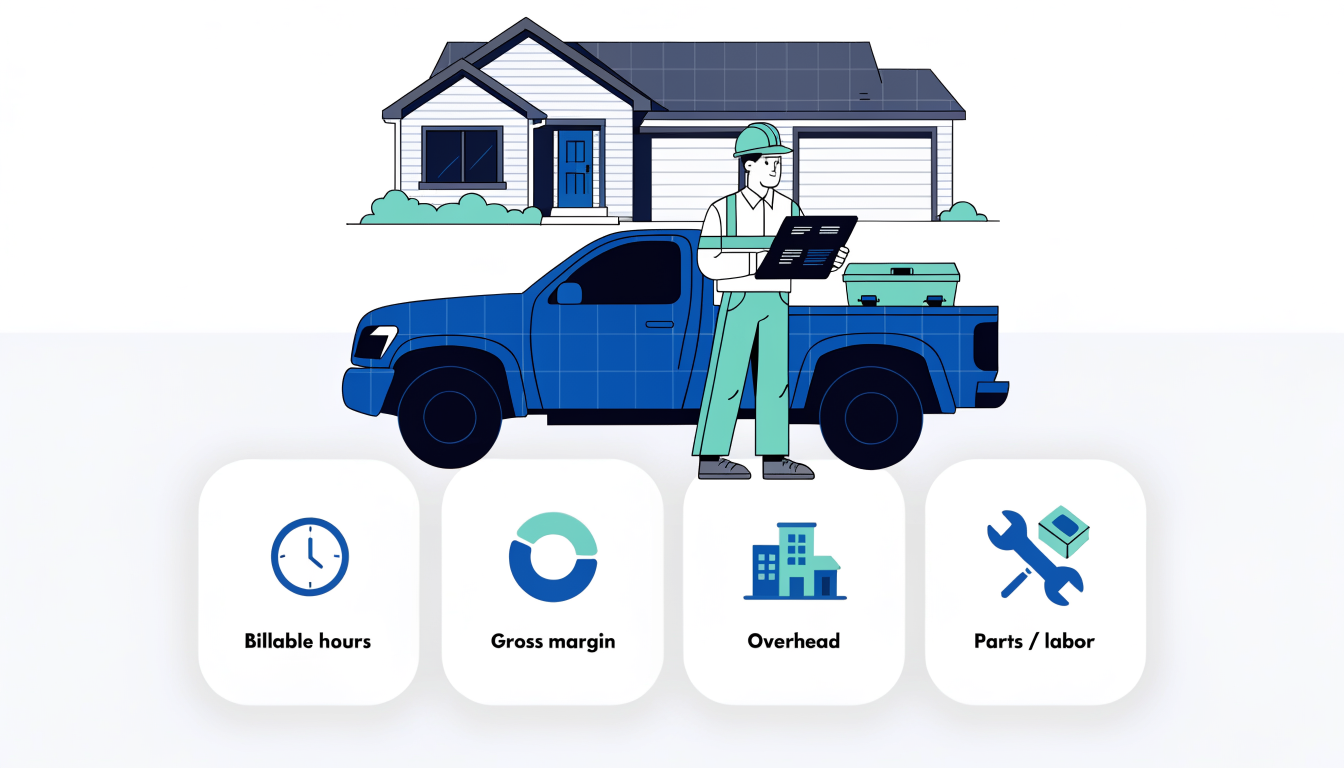
Why these numbers beat “how busy am I?”
Ask most owners how the business is doing and you’ll hear “busy” or “slammed.” That feels like success. It isn’t the same thing.
You can be booked solid and still not have money at the end of the month. You can turn away work and still be more profitable than the guy with three trucks. Being busy tells you how much work you’re doing. It tells you nothing about whether that work is making you money.
The numbers below are the ones that actually tell you. None of them require an accounting degree. You just have to know them and check them.
The four numbers every home services business should know
1. Billable hours (how many of your hours you get paid for)
What it means: You work a full day, but you don’t get paid for every minute of it. Driving between jobs, loading the truck, buying parts, doing paperwork at night — that’s all time you can’t put on a customer’s bill. Billable hours are the ones you can charge for.
What healthy looks like: For most home services work, about 55% to 70% of your working hours end up billable. If you work and get paid for 40 hours but only 25 of them land on customer invoices, that’s about 63%.
Why it matters: This is the number owners get most wrong. It feels like you’re working a full 40-hour week, so it feels like you should be billing 40 hours. You never are. The gap between the hours you work and the hours you bill is real, and it’s exactly why your hourly rate has to be higher than you’d think. (We do that math in the next guide, How Much Does It Really Cost to Send a Tech to a Job?.)
2. Gross margin (what’s left after a job’s own costs)
What it means: Take what a job brings in. Subtract the costs that belong only to that job — your time, the materials, any permits or dump fees. What’s left, as a percentage, is your gross margin.
What healthy looks like:
| Type of work | Healthy gross margin |
|---|---|
| Service and repair | 50–65% |
| Replacement and install | 35–50% |
| New construction | 25–40% |
Why it matters: Gross margin is the earliest warning light you have. You can look at last week’s jobs and know right away if you priced them right. If a service call comes back at 35% margin when it should be 55%, something’s off — bad pricing, a job that ran long, or parts that cost more than you charged. You catch it in days instead of finding out at tax time.
3. Overhead (what it costs to keep the business running)
What it means: Overhead is everything you pay for that isn’t tied to one specific job — your truck, insurance, phone, software, advertising, and the time you spend on nights-and-weekends paperwork. For a one-person shop, you are the office. Your admin time and your business bills are the overhead.
What healthy looks like: For a small operation, overhead usually runs 15% to 30% of what you bring in. It tends to go up as you grow, not down — because growing means adding a helper, then software, then maybe someone to answer the phone.
The trap for solo owners: If you don’t pay yourself a real wage, your overhead looks tiny and your business looks super profitable. It isn’t. You’re just hiding your own unpaid work. Put a fair salary for yourself into the math, even if you can’t take it all home yet. Otherwise you’re fooling the one person you can’t afford to fool.
4. Parts-to-labor mix (how much of a job is materials versus your time)
What it means: On a typical job, how much is parts and how much is your labor? A drain cleaning is almost all labor. A water heater swap is heavy on the part.
Why it matters: It tells you where to be careful with pricing. If your work is mostly labor, getting your hourly rate right is what matters most — a small mistake there costs you on every job. If your work is parts-heavy, your markup on materials matters more. You don’t need a target here. You just need to know which kind of business you’re running so you focus your attention in the right place.
When to trust the default numbers and when to change them
The Service Pricing Calculator starts you with typical numbers for your trade. Those are a smart starting guess — not the final answer for your business.
Use your own numbers instead when:
- You’ve tracked your real numbers for a few months. Real always beats typical.
- Your work is unusual for your trade — like a plumber who mostly does new-construction rough-in.
- You work somewhere with long drives or high costs that the average doesn’t know about.
Stick with the defaults when:
- You’re just starting out and don’t have your own numbers yet.
- Your business feels pretty normal for your trade and you just want a sanity check.
What to do with these numbers
Knowing them is step one. Using them is where the money is.
Check them once a month. Pick a day. Write down the four numbers. Watch which way they’re moving.
Look into anything that jumps. If your margin drops a few points in a month, something happened. Go find out what.
Set a goal, not just an average. “Healthy” is a range. Pick where in that range you want to be a year from now, and work toward it.
That’s it. Four numbers, checked monthly. It’s less work than a single service call, and it’s the difference between guessing and knowing.
The next step is turning these numbers into a real hourly rate. That’s the next guide: How Much Does It Really Cost to Send a Tech to a Job?
Frequently Asked Questions
How do I know if my home services business is doing well?
Don’t judge it by how busy you are. Check four numbers: how many of your hours you can bill, your gross margin per job (aim for 40–60%), your overhead (usually 15–30% of revenue), and how parts-heavy your jobs are. Healthy numbers matter more than a full calendar.
What is a good profit margin for a trade business?
Gross margin (what’s left after a job’s own costs) should run about 50–65% for service and repair work and 35–50% for installs and replacements. If you’re well below that, your pricing or your job mix probably needs a look.
How often should I check my business numbers?
Once a month is enough to catch problems early. Do a deeper review every few months, and reset your targets once a year or whenever something big changes.
I’m a one-person business. Do these numbers still apply to me?
Yes — with one rule: pay yourself a real wage on paper. If you leave your own pay out of the math, your business looks more profitable than it is, and you’ll price too low without knowing it.